In stochastic volatility models, the variance $v_t$ is a random process of its own, driven by a second Brownian motion correlated with the spot:
\[dS_t = (r - q)\,S_t\,dt + \sqrt{v_t}\,S_t\,dW^S_t\] \[dv_t = \alpha(v_t, t)\,dt + \beta(v_t, t)\,dW^v_t, \qquad d\langle W^S, W^v \rangle_t = \rho\,dt\]Heston is the case $\alpha = \kappa(\theta - v_t)$ and $\beta = \xi\sqrt{v_t}$.
Note: in the first SDE, the model gives the dynamics of the variance $v_t$, that’s why the volatility is not mentioned. In the second SDE, $\beta$ is the volatility of the variance (“vol of vol”).
Forward skew
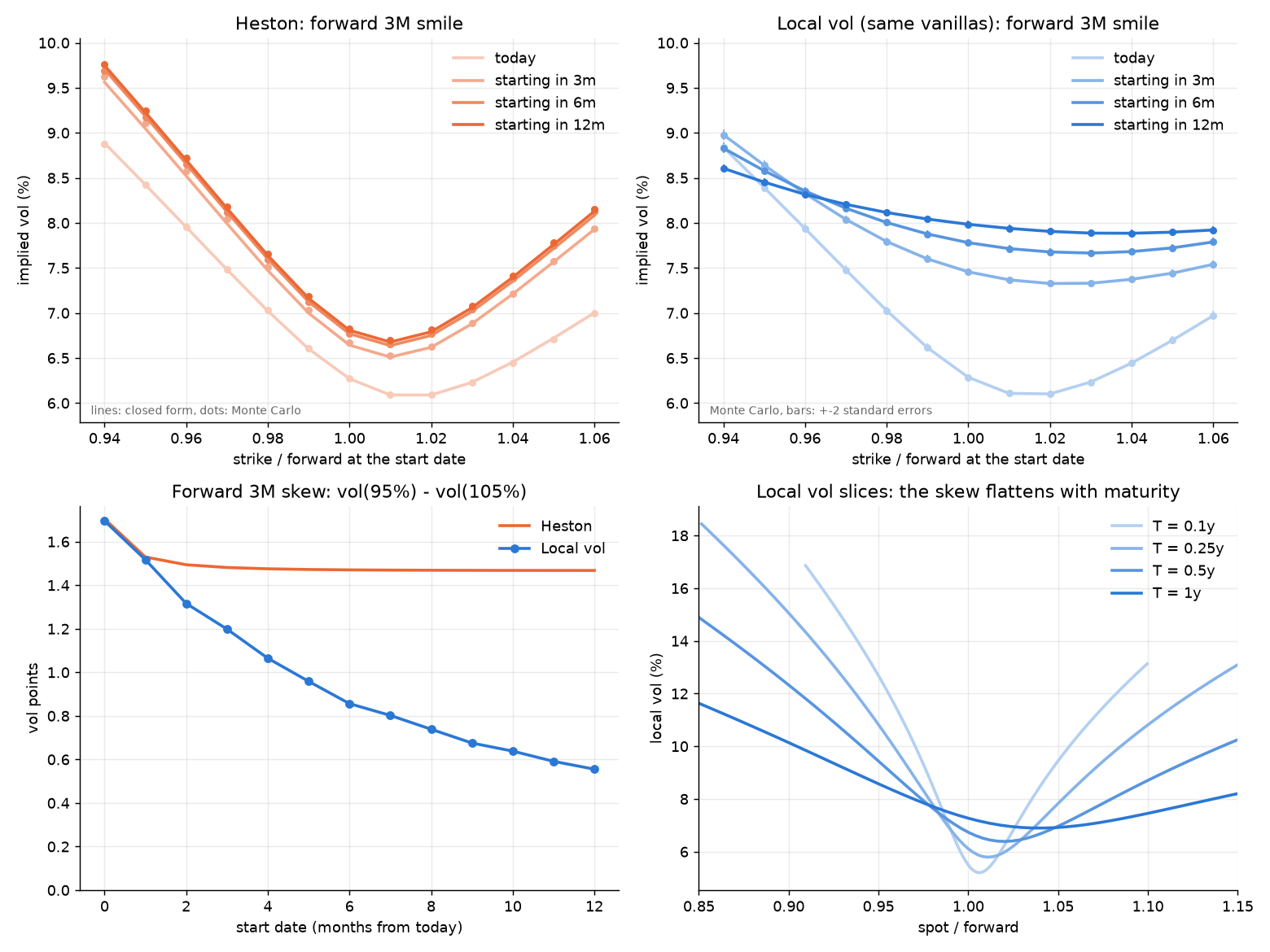
When simulating, the prices at future dates $t > t_0$ (today) give the forward smile: starting from them, we price options and invert Black-Scholes to get the implied vol at that future date.
Doing this for several start dates shows how the skew changes over time (figures below).
The stochastic vol model keeps the forward skew much better than local vol, which flattens it.