Exotic components
Exotic products are not quoted on the market: their price is only an estimate given by the model. An exotic component is useful to represent a specific risk driver of the product.
Investor exposure
- Long zero-coupon bond -> vanilla
- Short worst-of down-and-in put -> exotic
- Long coupons -> vanilla (replicable with Treasury STRIPS, i.e. a strip of zero-coupon Treasury bonds)
- Short autocall -> exotic
Termsheet (core components)
2Y USD 14% p.a. Autocallable Multi Reverse Convertible (55% European) on Microsoft, Oracle
- Barrier = 55%, European
- Strike = 65%
- Autocall level = 100%
Calibration step
TODO: elaborate this step.
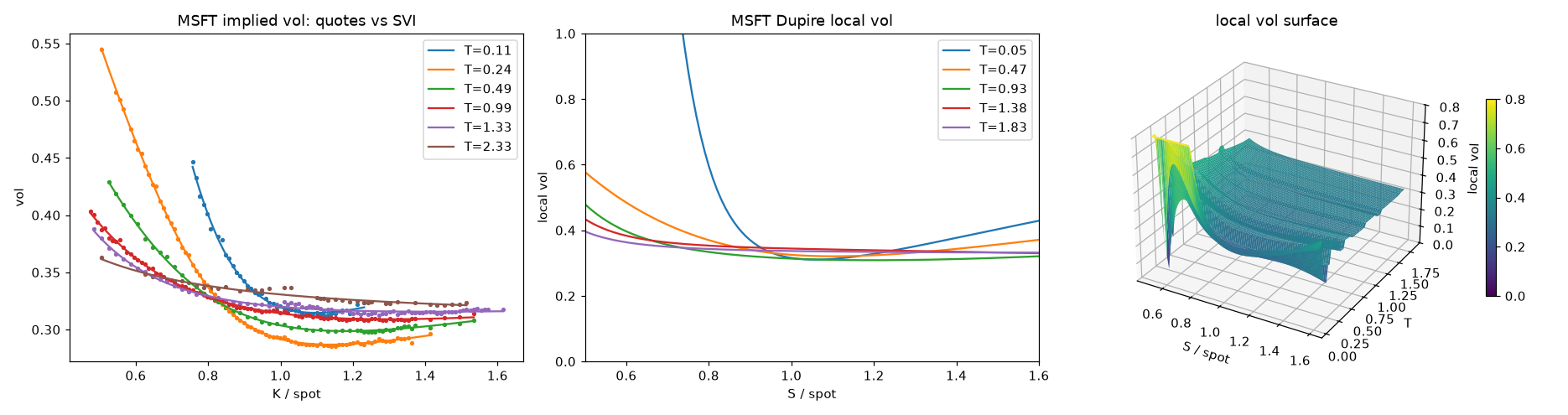
Note: at low spot, the surface has holes. These come from our SVI fit/interpolation that is too simplistic (missing a no-arbitrage constraint).
Pricing steps
1/ Load the inputs
2/ Simulate correlated paths under local vol
- Use Cholesky to generate correlated returns
- Build the grid -> list of uniform (all trading dates + insertion of important dates like observation/calling dates)
- Simulate the price at each step using the local vol SDE
Note: when simulating, the price at a future step can be called “forward”.
We say that the local vol model underestimates the forward skew (vol), because, based on forward (simulated) prices, we could potentially deduce the implied volatility (e.g. reverting B-S). The result would give a surface that is too flat compared to the current one -> TEST THIS (and compare with a stochastic model).
3/ Check the simulations
- Check martingale: $\mathbb{E}[S(t)]$ (simulation) should be equal to the $F(t)$ (deduced from Call-put parity)
4/ Compute the worst-of
- Observed at valuation dates
5/ Build the cashflows
- Cash flows are mostly principal repayment (if called) + coupon
- Cash flows are paid at payment dates
6/ Discount and average
- Use of the risk-free rate
7/ Describe the redemption profile
- Autocall probabilities: proportion of paths that triggers an autocall
- Barrier probabilities
-> computed in order to understand better the price
8/ Solve for the fair coupon at inception
- Based on the redemption price (price decomposition)
9/ Run sensitivities
- Stress test some parameters like correlation or funding spread